
Trust Roofing Services Nottingham
Chimney Cap Installation & Weatherproofing in Nottingham — Protect Your Home Before the Damage Spreads
Trusted by homeowners across Nottinghamshire | Free Drone Survey | 10-Year Workmanship Guarantee | Fully Insured | No Subcontractors | BBA-Approved Materials
0115-647-3275
Chimney cap installation and weatherproofing in Nottingham is one of the most cost-effective things you can do to protect your home from long-term water damage. Nottinghamshire's older housing stock — Victorian terraces in Arnold, Edwardian semis in Beeston, period properties in Mapperley and West Bridgford — faces a genuine battering from wet East Midlands winters, freeze-thaw cycles, and strong south-westerly winds.
A missing, cracked, or poorly fitted chimney cap does not just let rain in. It allows frost, birds, debris, and downdraught into your flue. Left alone, that moisture tracks down the inside of the stack, into the chimney breast wall, through internal plasterwork, and into ceiling timbers. What starts as a small job becomes a large one very quickly.
We cover chimney cap fitting, cowl selection and installation, chimney waterproofing, lead flashing repair, flaunching repair, bird guards, and full stack weatherproofing — for both active and disused chimneys — across all NG postcodes.
We are Trust Roofing Services, a family-run roofing team based in Hucknall with over 15 years of hands-on chimney and roofing experience across Nottinghamshire. Every job starts with a free drone roof survey so you know exactly what you are dealing with before any work begins.
📞 0115-647-3275 | Free Quote | No Obligation
What Does Chimney Cap Installation and Weatherproofing Actually Cover?
People often come to us having searched for "chimney cap Nottingham" or "chimney cowl fitting near me" — and they are not always sure what the difference is, or which service they actually need. Here is a plain-language breakdown of what falls under this service:
- Chimney cap fitting — a protective cover placed over a disused flue or chimney pot to block rain, debris, and wildlife
- Chimney cowl installation — fitted to active flues to protect and ventilate simultaneously; prevents downdraught and rain ingress
- Chimney weatherproofing — a broader term covering the lead flashing, flaunching mortar, chimney crown, sealant work, and repointing around the stack
- Bird guard fitting — mesh guards that prevent starlings, jackdaws, and other birds from nesting inside your flue
- Chimney flaunching repair — the mortar collar around the chimney pot that cracks over time and lets water into the top of the stack
- Lead flashing repair — the metal seal where the chimney meets the roof; one of the most common causes of chimney-related damp inside the home
- Chimney waterproofing treatment — breathable sealant applied to the masonry to repel water without trapping moisture inside the brick
- Chimney stack repointing — raking out failed mortar and replacing it to stop water tracking between the bricks
If your chimney is leaking, damp, blocked, or uncapped — we can diagnose it, quote it, and fix it. Call us on 0115-647-3275.
Chimney Cap vs Chimney Cowl — Which One Does Your Nottingham Property Need?
This is the question we get asked most. These two products are often confused — and fitting the wrong one creates new problems rather than solving existing ones.
A chimney cap is designed to fully or partially close off a flue that is no longer in use. It blocks rain, wildlife, and debris. It does not allow combustion gases to escape, so it must never be fitted to an active fire or stove.
A chimney cowl is designed for active flues. It protects the top of the pot from rain and wildlife while still allowing smoke and gases to pass through safely. Anti-downdraught cowls go one step further — they use the wind to create negative pressure inside the flue, pulling gases out rather than letting wind push them back down.
Before we specify anything on your property, we assess three things:
- Whether the flue is active, redundant, or connected to a stove or liner
- The chimney pot size, condition, and whether the flaunching is sound
- Wind exposure on your roofline and the direction of prevailing weather
Why This Matters for Nottingham Properties Specifically
Many properties across Mapperley, Sherwood, and Arnold have shared party-wall stacks with two or more flues inside a single chimney. Each flue needs individual assessment. A cap or cowl that works perfectly on one flue can affect the draw on the adjacent flue — particularly where one is connected to a wood-burning stove and the other is redundant.
Properties in Hucknall, Arnold, and on higher ground across NG5 and NG15 are also more exposed to wind-driven rain and downdraught. A standard rain cap will not solve a downdraught problem. Only an anti-downdraught cowl — correctly sized and positioned — will fix it properly.
Not sure which product you need? Call us on 0115-647-3275. We will give you a straight answer.
How to Tell If Your Chimney Cap, Flaunching, or Lead Flashing Is Failing
Water getting into a chimney is rarely obvious at first. By the time a damp patch appears on your chimney breast wall, water has often been working its way through the masonry for weeks or months. Here are the warning signs we see most often on Nottingham properties:
- Damp patch or brown staining on the chimney breast wall — appears or gets worse after rain
- Staining on the ceiling in the room directly below or adjacent to the chimney stack
- Water dripping into the fireplace opening during or after heavy rainfall
- White chalky staining on the outside of the stack — this is efflorescence, a sign of moisture moving through the masonry
- A musty or damp smell from a bricked-up fireplace — almost always condensation inside a sealed, unventilated flue
- Spalling brickwork — brick faces flaking away after repeated freeze-thaw cycles
- Cracked or sunken flaunching — the mortar collar around the pot has broken and water is soaking in at the top
- Visible gaps in the lead flashing at the base of the stack where it meets the roof tiles
The South-Westerly Wind Problem in Nottinghamshire
Not all chimney damp comes from the top. Nottingham's prevailing south-westerly winds drive rain directly into the face of exposed chimney stacks. If your damp patch only appears after wind-driven rain from a specific direction, the cause is almost always the wind-facing lead flashing or mortar pointing — not the chimney cap. Replacing the cap alone will not solve it. We see this mistake made regularly on Nottingham properties, where a cowl has been fitted by another contractor without diagnosing the actual entry point.
We use our free drone survey to inspect the full stack — cap, pot, flaunching, lead flashing, mortar joints, and the junction between the stack base and the roof tiles — before recommending any work. You see exactly what we see. No guesswork, no inflated scope of works.
How We Install and Weatherproof a Chimney Cap — Step by Step
Here is exactly what happens from the moment you call us to the day the scaffold comes down.
Step 1 — Free Drone Survey and Written Quote
We fly the drone before anyone goes near a ladder. You receive HD images of the full stack — cap, pot condition, flaunching, lead flashing, mortar joints — and a clear, itemised, no-obligation written quote. No other roofer in Nottingham offers this as standard. It means you know the full picture before committing to anything.
Step 2 — Scaffolding and Safe Access
All chimney work at height requires scaffolding for safe working. On narrow terraces in Sherwood, Lenton, Basford, or Bulwell, we account for kerbside access and advise on parking suspension requirements in advance. No surprises on the day.
Step 3 — Detailed Physical Inspection on the Scaffold
Once we are at stack level, we always find things the drone could not catch — a hairline crack in the pot, a lifted edge of lead flashing, cracked flaunching hidden under moss growth. We photograph everything and discuss findings with you before a single piece of work begins.
Step 4 — Cap, Cowl, or Weatherproofing Installation
Depending on what your chimney needs, we carry out one or more of the following:
- Remove the old cap or cowl if damaged, incorrectly specified, or past its life
- Measure the pot precisely — cap and cowl must match the pot; universal-fit products rarely seal properly
- Fit and seal the cap or cowl around the full base perimeter using silicone or mortar
- Repair or rebuild the flaunching where it has cracked, sunk, or detached from the pot
- Re-dress or replace lead flashing to create a proper watertight seal at the roof junction
- Fit a bird guard where nesting has been identified or is a recurring issue
- Apply chimney waterproofing treatment to the masonry where water absorption is a problem
Step 5 — Sign-Off, Photos, and Clean-Up
We photograph all completed work from the scaffold before it is dismantled. You receive a written record of everything done. The site is left clean and tidy. For a single-stack cap installation on a standard Nottingham terrace, the work is typically completed within one day once the scaffold is in position.
Disused Chimneys in Nottingham — Capping, Ventilation, and Preventing Damp
This is one of the most common jobs we carry out across Nottinghamshire. Terraces in Hyson Green, Bulwell, Bestwood, and Basford commonly have multiple bricked-up fireplaces. Many homeowners have sealed the opening inside the room but left the top of the stack completely open. That is where the trouble starts.
Rain, birds, and debris enter freely from above. With no heat moving through the flue to help it dry out, moisture sits inside the masonry. It erodes the mortar from the inside. It migrates into the chimney breast wall. And eventually, it shows up as a damp patch that seems to appear from nowhere.
The Most Common Mistake — Fitting a Solid Cap
A solid C-cap on an unventilated, redundant flue will make the problem worse, not better. Sealing a damp flue with no airflow traps moisture inside. British Standard guidance on ventilation of redundant flues recommends maintaining airflow even when the chimney is no longer in use. The correct approach is:
- A vented cap or pepper pot insert at the top — blocks rain and birds while allowing air to circulate through the flue
- An air brick at the fireplace opening inside the room — completes the ventilation loop so air can move through the flue from bottom to top
- A full inspection of the flaunching and mortar joints while we are at the top — because once the scaffold is up, it is the right time to catch and fix secondary issues
We confirm whether every pot on a party-wall stack connects to a live or dead flue before specifying anything. Where one flue is still connected to an active wood burner, a poorly specified product on the adjacent redundant flue can impair the active flue's draw. This is a detail that is regularly missed — and one that we never skip.
Chimney Cap and Cowl Materials — What to Specify and Why It Matters
Not all chimney caps and cowls are built the same. The material you choose affects how long it lasts, how well it handles Nottinghamshire winters, and whether you are calling us back in a few years to replace it again.
Here is a plain-language guide to the main options.
Galvanised Steel
Galvanised steel is the most common and lowest-cost option. On a sheltered, low-exposure stack it can last anywhere from 5 to 15 years. The problem is Nottinghamshire's freeze-thaw winters. A galvanised cap that looks perfectly fine in September can begin to rust and weaken before the following spring on an exposed stack in Arnold, Carlton, or Gedling. If your chimney faces south-west — directly into the prevailing weather — galvanised steel is a short-term fix, not a long-term solution.
Stainless Steel
Stainless steel is the best all-round choice for most Nottingham properties. It handles freeze-thaw cycles, driving rain, and UV exposure without corroding. A good stainless steel cap or cowl will last 25 years or more with no maintenance. It costs more upfront than galvanised, but across its lifetime it is significantly better value. This is what we specify on the majority of chimney cap installations we carry out across Nottinghamshire.
Copper
Copper is the premium option. It outlasts every other material — a well-fitted copper cap can last 50 years or longer. Over time it weathers to a natural green patina that sits well against the older brick of period properties. For homes on The Park estate, in the Mapperley Park conservation area, or any Listed property across Nottinghamshire, copper is often the most appropriate choice both aesthetically and practically.
Plastic and PVC C-Caps
Plastic and PVC caps are the cheapest option and are suitable only for disused flues in sheltered positions. They are not appropriate for exposed stacks, active flues, or any chimney that takes significant weather exposure. We fit them occasionally on well-protected redundant stacks but would not recommend them as a general solution on Nottinghamshire rooflines.
Lead
Lead has been used on chimneys for centuries and remains a durable, long-lasting material when correctly fitted. It is most commonly used on traditional and period properties for flashing and weathering work rather than caps themselves, but lead chimney covers do exist for certain disused stack applications. Lead work requires specialist fitting and is not a DIY product.
The material that is right for your chimney depends on its exposure, whether the flue is active or redundant, and the character of your property. We tell you exactly what we are specifying and why before we order anything — not after the work is done.
Chimney Waterproofing, Flaunching Repair, and Lead Flashing — The Full Picture
Fitting a cap or cowl is only part of chimney weatherproofing. On most Nottingham properties we visit, there are one or more additional issues contributing to water ingress. Here is what we check and address as part of a full weatherproofing visit:
Chimney Flaunching Repair
Flaunching is the sloped mortar collar around the base of the chimney pot. It sheds water away from the top of the stack. When it cracks — and it almost always does over time on older Nottinghamshire properties — water soaks into the top of the stack and begins working its way down. Cracked flaunching is one of the most common causes of chimney damp we see across Nottingham, particularly on properties in Hucknall, Arnold, and Beeston.
We rake out failed flaunching completely and rebuild it from scratch with the correct mortar mix. Pointing over the top of cracked flaunching does not last — it needs to be done properly.
Lead Flashing Repair and Replacement
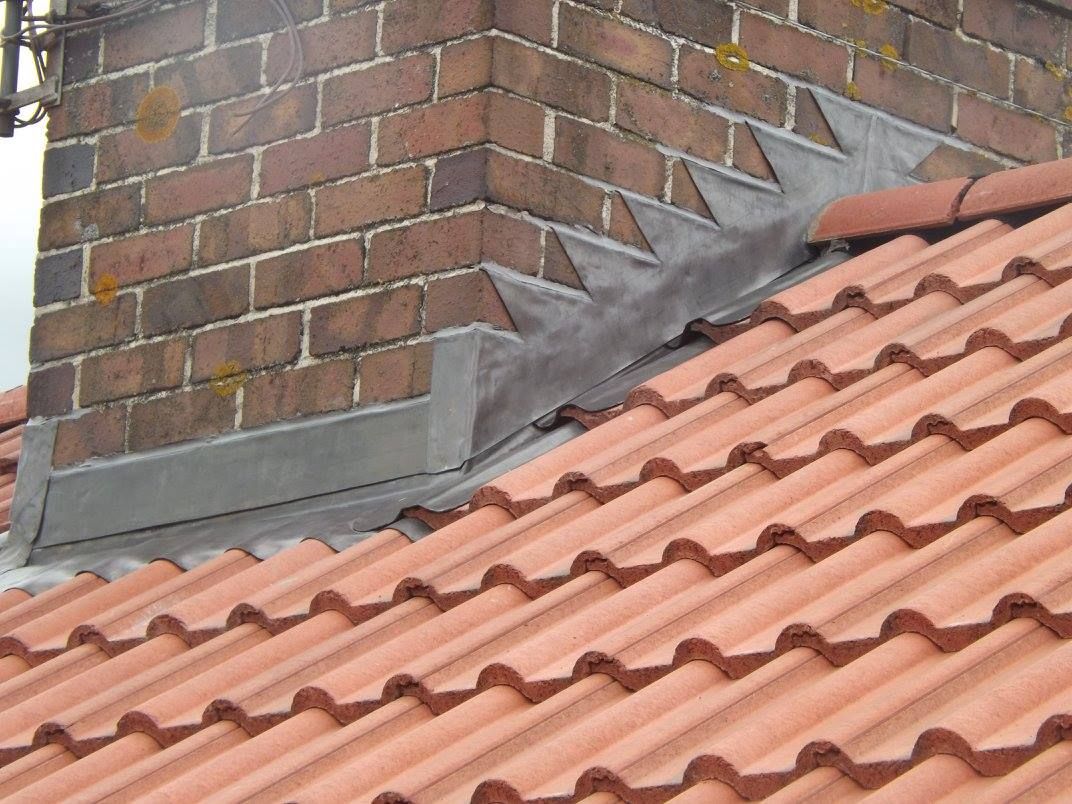
Lead flashing is the metal weatherproofing seal where the chimney stack meets the roof slope. When it lifts, splits, or pulls away from the chase cut into the stack, rain can track directly into the roof structure. This is the single most common cause of chimney-related damp showing up on ceilings inside a Nottingham home.
We re-dress lifted or deformed lead flashing where possible. Where the flashing has failed completely or was incorrectly installed previously, we replace it with new lead work finished to a proper watertight standard. See our lead work and lead flashing page for more detail on this.
Chimney Crown and Stack Waterproofing
Chimney crown waterproofing involves applying a breathable, penetrating sealant to the face of the brickwork and mortar. This reduces water absorption without trapping moisture inside the masonry — a common problem with non-breathable products applied incorrectly. We use this treatment on stacks where the brickwork is sound but absorbing too much water, particularly on south-facing and west-facing stacks that take the full force of the weather.
Chimney Pot Replacement
Where a chimney pot is cracked, loose, or structurally compromised, we replace it at the same visit. A cracked pot allows water into the flaunching and down the inside of the stack. We match the replacement pot to the existing style where possible, which matters particularly on older properties in areas like The Meadows, Lenton, or Carlton.
HETAS Compliance and Cowl Sizing for Wood-Burning Stove Installations
If your chimney cap or cowl is being fitted alongside a wood-burning stove or newly installed flue liner, the sizing is a safety requirement — not a rough guide.
A cowl that restricts airflow through the flue causes smoke blow-back into the room. In a properly sealed installation with a wood-burning stove, restricted airflow also creates a carbon monoxide risk. The cowl's free exit area — the open space through which smoke and gases escape — must equal or exceed the cross-sectional area of the flue liner below it.
Before fitting any cowl to a lined flue, we check:
- Flue liner diameter — typically 125mm, 150mm, or 180mm for most domestic wood-burning stoves
- Whether the pot-hanger cowl matches the liner diameter exactly, not just the pot
- Clearance between the pot top and the underside of the cowl
- Cowl free exit area versus the flue cross-section
Many Nottingham homeowners have had wood-burning stoves installed in the last decade under Clean Air Act exemptions, often with HETAS certification. An incorrectly sized cowl fitted after the original installation can affect the draw performance recorded at commissioning. If the stove is subsequently inspected, the wrong cowl matters — and the liability sits with whoever fitted it without checking.
We advise on HETAS compliance at the survey stage. Where the job involves a connected solid fuel appliance, we make sure everything we fit works correctly for the full system — not just the visible top of the chimney.
Why Choose Trust Roofing Services for Chimney Cap Installation in Nottingham?
We are a family-run roofing and chimney team based in Hucknall, covering all NG postcodes across Nottingham and Nottinghamshire. Here is what we bring to every chimney cap and weatherproofing job:
- ✅ Free drone roof survey — you see the full condition of your stack before spending a penny
- ✅ Free, itemised, written quote — no verbal estimates, no hidden costs, no shock invoices
- ✅ Over 15 years of hands-on chimney experience across Nottinghamshire's varied housing stock
- ✅ Fully insured — public liability and employer's liability insurance as standard
- ✅ No subcontractors — ever. Every job is carried out by our own directly employed team
- ✅ BBA-approved materials — the same brands and specifications used on the original installation
- ✅ Correct materials specified upfront — stainless steel, copper, or vented cap depending on your chimney, not the cheapest option
- ✅ 10-year workmanship guarantee on all chimney cap installation and weatherproofing work
- ✅
Honest diagnosis — we identify and fix the actual cause, not just the obvious symptom
Frequently Asked Questions — Chimney Cap Installation & Weatherproofing Nottingham
What is a chimney cap and what does it do?
A chimney cap is a protective cover fitted over the top of a chimney pot or flue opening. It stops rain, birds, debris, and small animals from entering the flue. On a disused chimney, it also prevents the stack from filling with water during wet weather, which would otherwise erode the internal mortar and track damp into the chimney breast. A correctly fitted cap is one of the simplest, most cost-effective ways to protect an older property from water damage.
What is the difference between a chimney cap and a chimney cowl?
A chimney cap closes off a flue — typically one that is no longer in use. It blocks everything from entering, including air. A chimney cowl is designed for active flues; it allows smoke and combustion gases to exit safely while protecting against rain, birds, and wind. Fitting a solid cap on an active flue creates a dangerous blockage. Fitting a basic cap on a redundant flue without ventilation can trap moisture inside the stack. The right choice depends on whether your flue is active or disused.
Do I need a chimney cap if my fireplace has been bricked up?
Yes. Sealing the fireplace opening at the bottom does not protect the top of the stack. Without a cap or vented cover at the top, rain, birds, and debris still enter from above. A sealed, unventilated flue also becomes a condensation trap — moisture builds up inside the stack and works its way through into the chimney breast wall. A vented chimney cap or pepper pot insert is the correct fix for a redundant flue.
How do I know if my chimney cap is failing?
Common signs include damp patches on the chimney breast wall that worsen after rain, brown staining on ceilings near the chimney, water dripping into the fireplace opening, white chalky efflorescence on the outside of the brickwork, or a musty smell from a sealed fireplace. From the ground, you may be able to spot a missing cap, a cracked pot, or sunken flaunching. A professional inspection — or a drone survey — will confirm the exact cause.
Can a chimney cap stop smoky smells coming into my home?
It can help, but smoky or musty smells inside the home have several possible causes. If the smell is from a disused fireplace, it is often condensation damp inside the sealed flue — a vented cap and internal air brick will usually resolve it. If the smell comes with smoke blow-back from an active fire, an anti-downdraught cowl is more likely the right fix. We inspect the full stack before recommending anything, because fitting the wrong product is a wasted expense.
What is chimney flaunching and why does it crack?
Flaunching is the sloped mortar collar around the base of your chimney pots, sitting on top of the stack. It is designed to shed rainwater away from the pot joints and down the sides of the stack. Over time — particularly on older Nottinghamshire properties — it cracks due to freeze-thaw weathering, thermal movement, and general age. Once cracked, it allows water to soak into the top of the stack. Repairing or rebuilding the flaunching is part of any proper chimney weatherproofing job.
Why does my chimney only leak when it rains heavily from one direction?
This is a very common pattern on Nottinghamshire properties. Nottingham's prevailing south-westerly winds drive rain hard into one face of the chimney stack. If damp only appears after wind-driven rain from a specific direction, the cause is almost always the wind-facing lead flashing or mortar pointing — not the chimney cap at the top. Replacing the cap alone will not stop it. The flashing or pointing on that face needs to be inspected and repaired.
Does fitting a chimney cap require planning permission?
For most standard properties, fitting a chimney cap or cowl does not require planning permission. However, if your property is Listed or sits within a conservation area — such as The Park estate in Nottingham or parts of Mapperley Park — any visible external alteration to the chimney may require consent from Nottingham City Council before work begins. We advise on this at the survey stage for every relevant property.
Can I install a chimney cap myself?
The product itself is easy to specify. The problem is safe access. Any chimney on a two-storey property requires scaffolding or a properly secured roof ladder for safe working at height. Attempting it without the right access equipment is a genuine safety risk. We carry out cap and cowl installations as part of a properly scaffolded visit, which means you pay for one access setup and we check the full stack while we are up there — not just the cap.
How long does a chimney cap last?
It depends on the material. Galvanised steel caps typically last 5–15 years on an exposed Nottinghamshire roofline before rust and weather degradation sets in. Stainless steel caps last 25 years or more. Copper caps can last 50 years or longer. We specify the right material for your chimney's exposure level — not the cheapest option that needs replacing in a few years.
How often should a chimney be inspected after a cap is fitted?
A visual check from the ground — using binoculars if needed — after any significant storm is a sensible habit. A professional inspection every two to three years is advisable for all Nottinghamshire properties, even where the chimney is unused. Nottinghamshire's winters accelerate mortar erosion, and a small problem caught early costs a fraction of what it costs when left to develop.
Will my home insurance cover a damaged chimney cap?
Sudden storm damage and impact damage are often covered under standard home insurance policies. Gradual deterioration, crumbling mortar, and wear-and-tear damage are typically excluded. If you are unsure whether what you are looking at is storm damage or wear, call us first. We will give you an honest assessment and let you know whether an insurance claim is realistic before you go down that route.
What is chimney waterproofing and do I need it?
Chimney waterproofing involves applying a breathable, penetrating sealant to the face of the chimney brickwork. It reduces the amount of water the masonry absorbs during rain without sealing the surface completely — which would trap moisture inside and cause more damage. It is useful on older stacks where the brickwork is still structurally sound but is absorbing too much water. It is not a substitute for repointing failed mortar joints or replacing failed flashing — those need to be done first.
Areas We Cover — Chimney Cap Installation Across Nottingham & Nottinghamshire
We are based in Hucknall (NG15) and cover all NG postcode areas across the city and county. Below are the main areas we regularly work in for chimney cap installation and weatherproofing:
Nottingham City and Inner Areas
- Nottingham City Centre — NG1
- West Bridgford — NG2
- The Meadows & Sneinton — NG2
- Mapperley & Carlton — NG3 / NG4
- Arnold & Sherwood — NG5
- Bulwell & Bestwood — NG5 / NG6
- Basford & Hyson Green — NG6 / NG7
- Radford, Forest Fields & Lenton — NG7
- Wollaton & Bilborough — NG8
- Beeston, Stapleford & Chilwell — NG9
- Hucknall (our base) — NG15
Greater Nottinghamshire
- Long Eaton & Sawley — NG10
- Clifton & Ruddington — NG11
- Radcliffe on Trent & Cotgrave — NG12
- Gedling & Netherfield — NG4
- Kirkby in Ashfield — NG17
- Sutton in Ashfield — NG17
- Eastwood & Kimberley — NG16
- Mansfield & Mansfield Woodhouse — NG18 / NG19
- Newark-on-Trent — NG24
Not sure if we cover your area? Call us on 0115-647-3275 and we will confirm straight away.
Ready to Get Your Chimney Capped and Weatherproofed? Book Your Free Survey Today
A damaged, missing, or incorrectly fitted chimney cap is not a problem that gets better on its own. Water in a chimney stack spreads — into the mortar, into the brickwork, into the chimney breast, and eventually into your ceiling and internal walls. The cost of sorting it early is always a fraction of what it becomes when left.
At Trust Roofing Services, we make this simple. We fly the drone, show you the problem in HD, give you an honest written quote, and carry out the work with our own directly employed team. No call centres, no subcontractors, no inflated scope of works. Just straight-talking chimney expertise from a local team that has been working on Nottinghamshire's rooftops and chimney stacks for over 15 years.
Call us today on 0115-647-3275 — or use our contact form — to book your free drone survey and no-obligation chimney cap installation quote.
We cover all NG postcodes across Nottingham and Nottinghamshire. Most surveys can be booked within days, not weeks.
📞 Trust Roofing Services — 0115-647-3275
📍 40 Harrow Road, Hucknall, Nottingham, NG15 6JD
✓ Free Drone Survey | ✓ Written Quote | ✓ 10-Year Guarantee | ✓ Fully Insured | ✓ No Subcontractors
Let’s talk about your FREE Drone Roof Survey which will Show you any problems that may require attention.
Fill out the form, or call us to discuss your requirements
0115-647-3275