Trust Roofing Services
Local Storm Damage Roof Insurance Claim Help
FREE Drone Survey
Free Quote
BBA-Approved Materials. 10-Year Guarantee.
Call: 0115-647-3275
Insurance Roofing Work & Storm Damage Claims Nottingham — We Handle the Roof, You Handle the Claim
Trust Roofing Services | Hucknall, Nottingham | Call: 0115-647-3275
Insurance roofing work and storm damage claims in Nottingham are something we deal with every week at Trust Roofing Services. Whether a recent storm has blown tiles off your roof, you've spotted water coming through your ceiling, your gutters have been torn away, or your insurer is already asking difficult questions — this page gives you straight answers and shows you exactly how we support you from the first inspection right through to final sign-off.
In Nottingham, Atlantic storm fronts push through the East Midlands from October right through to March each year. Properties across Hucknall, West Bridgford, Sherwood, Arnold, Beeston, and Bulwell regularly see wind-lifted ridge tiles, torn lead flashing, cracked verge mortar, and displaced chimney haunching. These aren't minor problems. Left unaddressed, they lead to water ingress, ceiling damage, and mould — and they give your insurer the ammunition to argue wear and tear rather than storm damage.
We're a family-run, local roofing contractor based on Harrow Road, Hucknall — and we know Nottingham's housing stock inside out. We carry out a free drone roof survey, produce a professional written inspection report, attend the loss adjuster visit alongside you, and complete all repair work to the agreed specification.
No pressure. No hidden costs. Written, fixed-price quotes every time.
📞 Call Trust Roofing Services now: 0115-647-3275
What Does Storm Damage to a Nottingham Roof Actually Look Like?
Most homeowners only see the obvious: a tile on the path or a damp patch on the bedroom ceiling. The damage your insurer will scrutinise is often far less visible from the ground.
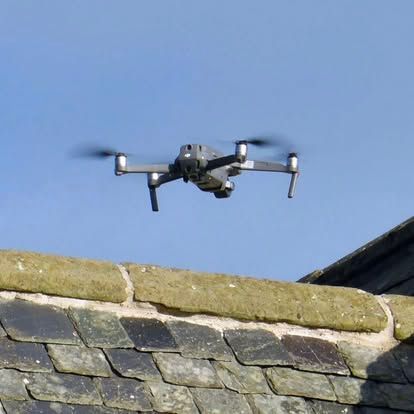
In Nottingham, we use our professional drone survey equipment to find damage that no one can spot from street level. We regularly find cracked or displaced clay and concrete tiles, lifted ridge caps, failed mortar on verge lines, and shifted lead flashing around chimney stacks. In properties with flat roof extensions — which are very common across Carlton, Bulwell, and Beeston — storm-driven rain can split or lift felt and EPDM membranes without leaving any obvious sign from outside.
Your insurer will cross-reference your claimed damage against Met Office weather records for your specific postcode and date. Wind speed, rainfall intensity, and hail data are all checked. If the records confirm a qualifying weather event, your claim stands on solid ground. If the records don't support it, the insurer may dispute the cause entirely — which is why early documentation matters so much.
Common Storm Damage We Find on Nottingham Roofs
- Missing or cracked concrete and clay tiles
- Lifted or displaced ridge caps and hip tiles
- Failed mortar on verge and ridge lines
- Displaced lead flashing at chimney junctions and valleys
- Gutter and fascia separation caused by wind loading
- Flat roof membrane damage from wind-driven rain and debris
- Loft water staining from sudden water ingress
- Cracked or dislodged chimney pots and haunching
- Damaged dry ridge and dry verge systems after high winds
Our free drone survey captures HD imagery of every part of your roof before any repair work starts. You see exactly what we see — and so does your insurer. No guesswork, no disputes about what was actually damaged.
How to Make a Roof Insurance Claim After Storm Damage — Step by Step
Getting the process right from the start makes the difference between a paid claim and a rejected one. Here is exactly what to do:
- Document the damage immediately. Take clear photos and video from the ground as soon as it is safe. Note the date and time. Do not climb onto the roof yourself.
- Call Trust Roofing Services on 0115-647-3275. We book your free drone roof survey — often on the same day or next day. We produce a professional written report with HD images, the cause of each failure, and a full itemised repair estimate.
- Check your buildings insurance policy. Confirm your excess, storm damage coverage, and any deadline for reporting a claim. Most UK insurers expect prompt notification.
- Contact your insurer. Report the damage and submit your inspection report, photographs, and any Met Office weather data for your postcode.
- Arrange the loss adjuster visit — with us present. Your insurer will send a loss adjuster. We attend that visit with you. We walk them through the findings, answer every technical question, and make sure nothing is overlooked.
- Get the agreed scope confirmed in writing. Do not allow any permanent repair work to begin until your insurer has confirmed in writing exactly what they will cover.
- We carry out all authorised repairs. Every job is completed to the agreed specification, with full completion documentation, invoices, and evidence provided for your insurer's records.
Your Insurer's Loss Adjuster Works for Them — Here's Why You Need an Independent Roofer First
A loss adjuster is appointed and paid by your insurance company. Their job is to assess the damage and protect the insurer's financial position. That does not make them dishonest — but their interests and yours are not the same.
Having a qualified, independent roofer inspect your roof before the adjuster arrives is the single most effective step you can take. We identify all damage — including secondary issues the adjuster is unlikely to look for. We produce a written report with photographic evidence, the likely cause of each failure, and a full itemised repair schedule. That document becomes your side of the conversation.
We also attend the loss adjuster visit alongside you. Loss adjusters are not professional roofers. They can and do miss things — particularly on complex rooflines, around chimney stacks, and on older properties with multi-pitch configurations. In Basford, Bulwell, and Hucknall, we regularly find chimneys with cracked haunching and displaced pot flashings that are only apparent during a detailed inspection at roof level.
The Difference Between a Loss Adjuster and a Loss Assessor
- Loss adjuster — appointed and paid by your insurer; assesses damage on their behalf
- Loss assessor — appointed by you; negotiates the full claim in your interest (charges a fee, usually a percentage of the settlement)
- Independent roofer (us) — provides expert technical evidence that you own and control
You are entitled to appoint your own roofer and obtain your own independent quote, regardless of what your insurer arranges. We have supported homeowners right across Nottingham through this process many times — from Hucknall and Arnold to West Bridgford and Long Eaton.
What You Should Do — and Should NOT Do — Before the Loss Adjuster Arrives
The first 24 to 72 hours after storm damage matter more than most homeowners realise. The actions you take — or don't take — in that window can directly determine whether your claim is paid in full, reduced, or rejected.
In areas like St Ann's and Sneinton, where Victorian terraced rows sit close together, storm damage can spread quickly between properties through shared roof structures. Acting fast protects your claim and your neighbours.
Do These Things Immediately
- Photograph everything from the ground and from inside the loft before any repair work takes place
- Cover exposed sections with a tarpaulin to stop further water ingress — this is expected by insurers and does not harm your claim
- Keep all receipts for any emergency materials or temporary work
- Notify your insurer promptly — most UK policies have a reporting window after the damage event
- Call Trust Roofing Services for a same-day or next-day drone survey before conditions change
Do Not Do These Things
- Do not carry out permanent repairs before the loss adjuster has visited and authorised the work
- Do not allow anyone to go onto the roof and move, remove, or alter damaged material before it has been photographed and documented
- Do not accept quotes from cold-knock roofing traders who appear on your street after a named storm — always use a verified, local Nottingham contractor
- Do not assume that because a named storm occurred, your claim will automatically succeed — evidence is still required
How We Carry Out Insurance-Approved Roof Repairs Across Nottingham
Once your claim is authorised, the repair must be carried out to the specification your insurer has agreed. In practice, this requires a contractor who understands the approval process, uses the correct materials, and provides the right documentation at the end.
At Trust Roofing Services, we carry out the full scope of insurance-approved repair work across Nottingham and all NG postcodes. We are a directly employed team — no subcontractors, no unknown faces turning up at your door. Every job is carried out by our own people, to our standard.
In areas like Arnold and Gedling, properties frequently mix natural Welsh slate with 1970s concrete interlocking tile extensions. Matching replacement materials correctly is something we deal with on every job. Using the wrong tile type — even one that looks visually similar — can give your insurer grounds to query the repair specification and withhold part of the settlement.
Insurance Repair Work We Carry Out Regularly
- Tile and slate replacement — matched exactly to existing material type and profile
- Ridge and hip tile re-bedding and dry ridge system installation as a storm-resistant upgrade
- Lead flashing repairs and full lead replacement at chimneys, valleys, and abutments
- Chimney stack repointing and haunching repair
- Felt, EPDM, and GRP flat roof repairs and full replacements
- Fascia, soffit, and guttering reinstatement following storm loading
- Emergency make-safe visits where water is actively entering the property
Every job is completed with a written report and an invoice that matches the agreed scope exactly. You receive full completion documentation for your insurer's records. Our 10-year workmanship guarantee applies to all repair work.
When Your Insurer Says "Wear and Tear" — How to Challenge It With Evidence
Wear and tear is the most common reason UK roof insurance claims are rejected. Your insurer argues the damage was gradual rather than sudden — and therefore not a covered event.
The critical point — confirmed by the Financial Ombudsman Service — is that an insurer must prove wear and tear was the primary cause of the damage. Pre-existing deterioration alone is not sufficient grounds for rejection. If a qualifying storm event clearly made existing conditions significantly worse, that matters and can be argued.
Nottingham has a large proportion of pre-1919 housing stock. Victorian terraces in Sherwood, Forest Fields, and The Meadows, and Edwardian semis throughout Mapperley and Sherwood Rise are all frequent targets for age-based disputes. Age of a property alone is not a valid rejection reason under Financial Ombudsman Service guidance. Your insurer must demonstrate the primary cause was deterioration — not the storm itself.
Evidence That Counters a Wear-and-Tear Rejection
- Dated photographs showing your roof was in sound, well-maintained condition before the storm
- Previous repair invoices demonstrating regular, ongoing maintenance
- A written inspection report from a qualified roofer documenting the damage and its most likely cause
- Met Office weather data for your exact postcode, confirming a qualifying storm event on the specific date
- Any prior Trust Roofing Services inspection report — we keep records on file for all previous customers
Our drone survey produces a dated, high-definition photographic record. If we've previously surveyed your property, that prior report can be used as a direct before-and-after comparison.
If your claim is still rejected after submitting this evidence, you can escalate to the Financial Ombudsman Service at no cost to you.
Will Making a Storm Claim Push Up My Home Insurance Premium?
Yes — in most cases, making any claim on your buildings insurance policy affects your no-claims record and raises your renewal premium. The scale of any increase depends on your insurer, your existing claims history, and the size of the payout.
Before filing a claim, it is worth comparing the cost of the repair against your policy excess plus a realistic estimate of any premium increases over the following two or three years. For minor roof repairs — a handful of slipped tiles or a small section of repointing — paying out of pocket is often the more cost-effective decision.
For significant damage — a full ridge section, storm-damaged flat roof membrane, structural tile loss, or chimney damage — the insurance route is almost always correct. The cost of major storm roof repairs in Nottingham can run into thousands of pounds.
If you are unsure whether to claim, call us first. We carry out your free drone survey, give you an honest repair estimate, and let you make an informed decision before you contact your insurer. There is no cost, no pressure, and no obligation.
Does the Age of My Roof Affect a Storm Damage Claim in the UK?
Yes. Roof age is one of the first things an insurer considers when assessing a claim. Older roofs are viewed as higher risk, and insurers may apply depreciation to reduce the payout on roofs beyond a certain age threshold.
Many UK policies will not cover a roof over 15 to 20 years old for leak damage, classifying deterioration as wear and tear rather than an insured event. For storm damage claims, age may still be raised as a factor — particularly if the insurer argues that a newer, well-maintained roof would have withstood the same conditions.
This does not mean older roofs cannot be covered. What it means is that maintenance records, dated inspection reports, and documented upkeep become even more important as your roof ages. If you own an older property — particularly the Victorian terraces found across Sherwood, Forest Fields, Hyson Green, and The Meadows — keeping a maintenance record is a practical step worth taking right now.
Our free drone survey gives you a documented, honest picture of exactly where your roof stands today. Call us on 0115-647-3275 to arrange yours.
Why Nottingham's Older Terraced Properties Need a Pre-Storm Roof Check
If you own a Victorian, Edwardian, or inter-war terraced home in Nottingham, pre-storm roof maintenance directly affects whether a future claim is paid. Full stop.
A roof with no inspection record, cracked mortar, moss-covered tiles, and blocked gutters gives a loss adjuster everything they need to argue wear and tear. A roof with a recent inspection report, clean gutters, repaired pointing, and replaced cracked tiles gives them almost nothing to work with.
In Nottingham's conservation areas — including Sherwood Rise and the Arboretum area — there are additional planning requirements for repair materials. Storm damage requiring tile replacement on a conservation area property must use tiles that match the original material type and profile. Using modern concrete tiles on a Victorian slate roof in a designated conservation area creates a planning compliance issue that can complicate insurance settlement further.
The Four Maintenance Steps That Protect Your Future Claim
- Annual or biennial roof inspection — producing a dated, written condition report
- Repointing of ridge and verge mortar before it becomes loose enough to be displaced in wind
- Gutter cleaning to prevent water backing up under tile courses during heavy rain
- Individual cracked or slipped tile replacement before the autumn storm season begins
Our free drone survey is the most practical starting point. We'll show you exactly what condition your roof is in, advise on any work needed before autumn arrives, and produce a written report you can file away for your insurer. Call us on 0115-647-3275 to arrange yours before the storm season gets going.
Frequently Asked Questions About Storm Damage Roof Insurance Claims in Nottingham
Should I call a roofer or notify my insurer first after storm damage to my roof?
Call your insurer first to formally start the claim and get a claim reference number. Then book an independent Nottingham roofer — like Trust Roofing Services — to carry out a full inspection before the loss adjuster visits. Having your own professional inspection report puts you in a significantly stronger position when the adjuster arrives. Never allow anyone to carry out permanent repairs before the adjuster has visited and authorised the work.
How do I prove my roof was damaged by the storm and not gradual deterioration?
Dated photographs, previous maintenance invoices, and a written inspection report from a qualified roofer are the three strongest pieces of evidence. We can produce that report through our free drone survey and provide it directly to your insurer. Met Office weather data for your postcode on the date of the storm is also a powerful supporting document — it is freely available and can confirm a qualifying weather event occurred.
Can I carry out temporary repairs to stop a leak without invalidating my claim?
Yes. Tarpaulin and emergency make-safe work are expected by insurers and are generally reimbursed as part of the claim settlement. Photograph the damage clearly before and after any temporary repair, and keep all receipts. Do not carry out any permanent repairs — tile replacement, lead work, flat roof patching — until the loss adjuster has visited and the scope of work has been formally agreed.
Do I have to use the contractor my insurer sends?
Not necessarily. Check your policy wording carefully. Many UK buildings insurance policies allow you to appoint your own qualified roofing contractor, as long as the quote is reviewed and approved by the insurer. We liaise directly with insurers and provide the itemised written documentation they require. Call us on 0115-647-3275 and we can advise you on your specific options.
Does a named storm like Storm Bert or Storm Darragh guarantee my claim will be approved?
No. A named storm creates a useful Met Office data trail for your postcode — but your insurer will still assess whether your specific property sustained damage caused by that event. A professional written inspection report linking the specific damage to the confirmed storm date and conditions is still required. The named storm supports your claim; it does not replace the need for documented evidence.
My roof is on an older Nottingham terraced house — can my insurer reject my claim purely because of the property's age?
Age alone is not sufficient grounds for rejection under Financial Ombudsman Service guidance. Your insurer must demonstrate that deterioration — not the storm — was the primary cause of the damage. A maintained roof with a documented inspection history is far harder to reject on age grounds. If your claim has been rejected purely on age, request a full written explanation and call us — we can advise on challenging it.
What wind speed does my insurer need before accepting a storm roof claim?
Most UK insurers follow the Association of British Insurers definition. A qualifying storm typically involves sustained wind gusts above 55 mph, heavy rainfall exceeding 25mm per hour, hail intense enough to crack or bruise hard surfaces, or snow accumulating to 30cm or more within 24 hours. Your insurer will verify the actual recorded conditions against your specific postcode using a licensed weather data provider — not general regional averages.
What happens if my roof insurance claim gets rejected?
Start by requesting a full written explanation from your insurer. Then commission an independent inspection report, gather Met Office data for your exact postcode, and compile any prior maintenance records or invoices. Submit a formal appeal with this supporting evidence. If your insurer maintains their position within eight weeks, you can escalate to the Financial Ombudsman Service (FOS) free of charge — this is an independent body that reviews disputed insurance decisions and regularly overturns insurer rejections where the evidence supports the homeowner.
Areas We Cover for Storm Damage Roof Repairs and Insurance Work
Trust Roofing Services is based in Hucknall and covers all Nottingham city areas and the wider Nottinghamshire region. If a storm has hit your property anywhere across the NG postcodes, we can be with you fast.
Nottingham City & Inner Areas
- Nottingham City Centre — NG1
- Hucknall — NG15 (our base)
- Arnold — NG5
- Carlton — NG4
- Sherwood — NG5
- Bestwood — NG5
- Bulwell — NG6
- Hyson Green — NG7
- Radford — NG7
- Forest Fields — NG7
- Lenton — NG7
- Beeston — NG9
- West Bridgford — NG2
- The Meadows — NG2
- St Ann's — NG3
- Sneinton — NG2
- Mapperley — NG3
Greater Nottinghamshire
- Gedling — NG4
- Netherfield — NG4
- Long Eaton — NG10
- Stapleford — NG9
- Clifton — NG11
- Ruddington — NG11
- Kirkby in Ashfield — NG17
- Sutton in Ashfield — NG17
- Mansfield — NG18 / NG19
- Newark-on-Trent — NG24
- Eastwood — NG16
- Ilkeston — DE7
Not sure if we cover your area? Call 0115-647-3275 and we'll confirm immediately.
Ready to Sort Your Storm Damage Claim? Here's Your Next Step.
If a storm has damaged your roof — or you suspect it may have — the single most important thing you can do right now is get a documented inspection completed before your insurer sends anyone out.
Trust Roofing Services carries out a completely free drone roof survey for every enquiry across Nottingham and Nottinghamshire. Our CAA-registered drone surveyor captures HD footage of your entire roof from multiple angles. You receive a clear, jargon-free written report — exactly the kind of professional evidence that supports a successful insurance claim.
We are a family-run local business based in Hucknall, with over 15 years of hands-on roofing experience across Nottinghamshire. We carry full public liability insurance. We use only BBA-approved materials. We never use subcontractors. And everything we do comes with our 10-year workmanship guarantee.
We have helped homeowners in West Bridgford, Arnold, Beeston, Carlton, Long Eaton, Hucknall, and across all NG postcodes make successful storm damage claims and get their roofs repaired properly. We know Nottingham's roofs — and we know how to fight your corner with your insurer.
Don't wait. The longer damaged areas are left exposed, the more your insurer can argue the subsequent water damage was preventable.
📞
Call Trust Roofing Services today: 0115-647-3275
🌐
Or visit: www.roofersnottinghamgrp.co.uk
Trust Roofing Services | Harrow Rd, Hucknall, Nottingham, NG15 6JD | 0115-647-3275
Serving Nottingham, Nottinghamshire, and the East Midlands — free drone surveys, no obligation.
Let’s talk about your Multi-Property and Estate Roofing Contract
FREE Roof Drone Survey
Fill out the form, or call us to discuss your requirements
0115-647-3275